Connect Word: Association Game
- 4.5
- Rating
- 5.00M
- Installs
- Free
- Price
 Analysis by App-foxy
I found Connect Word: Association Game most enjoyable when I treated it less like a speed test and more like a small daily exercise in flexible thinking. The basic idea is easy to understand: words belong to different topics, and I have to recognize which ones fit together before arranging them into groups. That simplicity is the game’s biggest strength, but it also sets a clear limit. This is a focused word puzzle, not a broad collection of mini-games or a deep competitive experience.
After spending time with it, my view is straightforward: this is a good choice for players who like association puzzles, short sessions, and the satisfaction of spotting a connection that was hidden in plain sight. It is less suitable if you want a story, a large range of game modes, or puzzles that always feel completely free from ambiguity. The best moments come from careful observation, while the weaker moments appear when several words seem equally plausible.
How the association puzzles work in practice
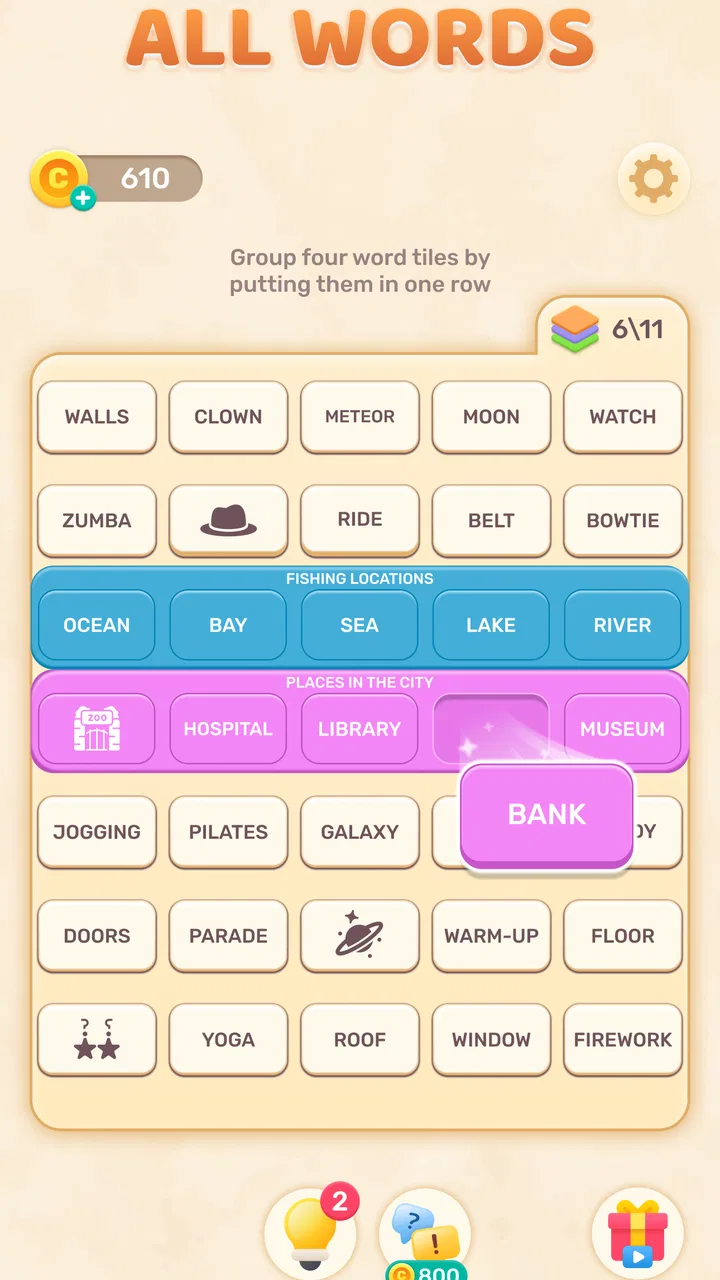
Each puzzle asks me to look at a collection of words and sort them into related sets. The challenge is not simply knowing definitions. I have to consider context, common phrases, categories, and the possibility that a familiar word is being used as a distraction. A word may appear to fit one group at first, only to make more sense somewhere else once the rest of the board becomes clearer.
You May Also Like

 AccuWeather: Weather Radar
AccuWeather Review: A Quick, Clear Forecast for Everyday Decisions
For everyday plans, the best forecast is the one you can understand quickly. AccuWeather makes rain timing, radar, and local conditions easy to act on, with a few trade-offs.

 Hill Climb Racing
Why Hill Climb Racing Still Turns Crashes Into One More Run
A tiny car, a bumpy hill and one more upgrade: Hill Climb Racing keeps resurfacing because its simple chaos makes every near-miss feel personal.

 AliExpress - Shopping App
AliExpress Makes Global Shopping Feel Personal, but Shoppers Bear the Risk
AliExpress turns a global marketplace into a pocket-sized discovery engine. Its reach is useful, its shopping loop compelling, and its trade-offs easy to miss.

 Lords Mobile: Kingdom Wars
Lords Mobile Is a Kingdom-Building Routine, Not a Quick Match
A case-by-case verdict on the building, battles, device demands, and social commitments that make Lords Mobile rewarding for some players and exhausting for others.

 PDF Scanner app - TapScanner
TapScanner Makes Paperwork Easier to Capture, Check, and Share
TapScanner makes scanning with a phone feel less like a rescue operation and more like a dependable step in getting work done. Its capture tools are useful, though not flawless.

 Block Blast!
 Shows How Much a Puzzle Game Can Leave Out
A quiet grid game shows why puzzle players increasingly value instant clarity, repeatable skill and low-pressure play—and where the genre still needs to catch up.
More From Our News Desk
View All News


That structure gives the game a pleasant two-stage rhythm. First, I scan for obvious relationships. Then I slow down and test whether the remaining words form a stronger group. I like that second stage because it rewards elimination rather than random tapping. When I make progress, it usually feels like I have improved my interpretation of the board, not merely guessed correctly.
The game comes from Hitapps Games and sits firmly in the word-puzzle corner of mobile gaming. It is free to start, with optional in-app purchases ranging from $0.99 to $79.99 per item. That makes it easy to try without committing money first, although anyone who dislikes purchase prompts or prefers a completely uninterrupted puzzle experience should pay attention to how the free version feels during regular play.
Its store summary describes the central task accurately, but the experience is more nuanced than simply matching words by topic. The real test is deciding which relationship is intended. A set can be connected by meaning, usage, or a shared theme, and the board often encourages me to question my first interpretation. That is where the game earns its place among casual brain teasers.
Why the central mechanic stays interesting
The strongest part of the design is the way it turns ordinary vocabulary into a reasoning problem. I do not need specialized knowledge to begin, yet I still have to examine words from several angles. This makes a short round feel more active than a simple word search. The game asks me to notice patterns, but also to resist the first pattern that appears.
One useful habit is to separate certain matches from possible matches. If three words clearly belong together, I avoid immediately forcing a fourth word into that set. Instead, I inspect the remaining options and ask whether the apparent fourth word has a more precise connection elsewhere. This approach is especially helpful when the puzzle includes overlapping themes.
Another practical technique is to start with the narrowest relationship rather than the broadest. A group based on a specific phrase or recognizable category is usually more reliable than a group based only on general meaning. I found that this reduces wasted attempts and makes the board easier to read. It also turns mistakes into useful information because a failed grouping shows me which interpretation needs reconsideration.
The game works well in everyday situations where I have only a few quiet minutes. I can play while waiting for an appointment, during a short break, or at the end of the day when I want something more engaging than scrolling. A realistic use case is a morning commute as a passenger: one puzzle gives my attention a clear target without requiring the long commitment of a traditional game.
The satisfaction of solving without overcomplication
I appreciate that the concept does not bury the wordplay under a complicated interface or a long tutorial. The focus remains on the board in front of me. That makes it approachable for people who enjoy vocabulary games but do not want to learn elaborate controls, upgrade systems, or a fictional world before reaching the actual puzzle.
It is also a reasonable option for casual family play, provided everyone is comfortable discussing possible meanings rather than treating every disagreement as a mistake. The puzzles invite conversation because one player may see a connection that another misses. However, the game is primarily designed for individual thought, so readers looking for a dedicated multiplayer word game should consider a different type of app.
The audience rating is Everyone, which matches the accessible nature of the word-based format. I would still distinguish “easy to start” from “always easy to solve.” A younger player may understand the controls immediately but find some associations difficult, while an adult with a larger vocabulary may still be challenged by misleading combinations. That variation is one reason the game can work across different skill levels.
Where the game creates genuine friction
The main weakness is the same feature that creates its best moments: association puzzles can feel subjective. Sometimes I can identify a defensible connection, but it is not the connection the puzzle expects. In those situations, the problem is not a lack of vocabulary. It is that several interpretations appear reasonable until the intended grouping becomes clear.
That kind of ambiguity can be satisfying when I eventually understand the distinction, but it can also become frustrating if I feel I am being asked to guess the author’s preferred wording. Players who enjoy lateral thinking will probably tolerate this better than players who want every answer to follow a strict, objective rule.
I also would not choose this game as my main source of long-form entertainment. Its appeal depends on the compact puzzle loop, and that loop is strongest in short bursts. If I keep playing when my attention is already tired, I become more likely to force connections or tap through a board without properly examining it. The game rewards patience, so marathon sessions can work against its best quality.
The free-to-play structure is another consideration. Because the game is free, it is accessible to a wide audience, but optional purchases can affect the experience depending on how a player reacts to prompts or assistance. I recommend trying the opening experience before deciding whether it deserves spending. The available purchase range is broad enough that users should make that decision deliberately rather than treating every small transaction as insignificant.
There is also a difference between this game and a conventional crossword. A crossword gives me a grid, crossing letters, and clues that usually constrain the answer in a visible way. Here, the uncertainty is semantic: I may know every word and still need to determine the intended grouping. A word-search game is more relaxed because the target words are generally fixed and the task is visual. Connect Word demands more interpretation, which is its advantage for some players and its drawback for others.
How I would approach a difficult board
When I get stuck, I avoid repeatedly trying random groups. Instead, I read every word again and classify the connections in my head. I look for words that can be paired with the same verb, words that belong to a narrowly defined subject, and words that might be names or parts of familiar expressions. This creates a mental map of possible relationships without committing too early.
A particularly useful approach is to protect the strongest group. If four words share a highly specific connection, I treat that group as an anchor and use it to reinterpret everything else. If the supposed group is broad, I leave it unconfirmed. This simple distinction helps prevent one attractive but vague connection from controlling the whole puzzle.
I also recommend taking a short pause rather than staring at the same arrangement indefinitely. Association puzzles often become easier after a brief reset because the mind stops repeating the same assumption. That is not a feature claim; it is simply the most effective way I found to use the game’s design. The board benefits from fresh attention more than from frantic speed.
For players who share a device with someone else, explaining why a group works can be more useful than announcing the answer. The explanation exposes whether the connection is precise or merely plausible. That makes the game a surprisingly good conversation starter, especially for people who enjoy comparing how differently two players interpret the same vocabulary.
Who should download it, and who should skip it
I would recommend this word game to anyone who likes category puzzles, vocabulary challenges, and mobile sessions that can begin and end quickly. It is particularly well suited to players who enjoy finding hidden structure in ordinary language. If you like the moment when several unrelated-looking words suddenly make sense together, the central mechanic has enough substance to keep you returning.
It is also a good fit for someone who wants a low-pressure mental break rather than an action game. There is no need to master reflexes or memorize a complicated control scheme. The challenge comes from reading carefully and revising assumptions. That makes it suitable for quiet breaks, relaxed evening play, or a short puzzle before putting the phone away.
I would steer competitive players toward another option if they need leaderboards, head-to-head matches, or a strong sense of measurable progression. I would also suggest a traditional crossword or a more rule-bound word game to anyone who becomes irritated by semantic uncertainty. Those formats provide different kinds of feedback and may feel fairer when the player wants every solution to be tightly constrained.
Players who dislike free games with optional purchases should make that preference part of the decision. The title costs nothing to begin, but the purchase range means it is worth checking whether the overall rhythm suits you before paying for anything. I would not spend simply because a difficult puzzle feels temporarily frustrating. The better test is whether I still enjoy examining the connections when I am not using assistance.
Device support and current place in the category
The game was released on April 17, 2024, and the current version is 2.7.2. It requires Android 8.0 or later, so users with older devices should check compatibility before planning to play. On supported phones, its concept is well matched to mobile use because the board can be considered in small portions rather than demanding a large screen or a long uninterrupted session.
Its audience is already substantial, with over 5 million installs and an average rating of 4.5 from around 278 thousand ratings. Those figures suggest that the format has broad appeal, although popularity alone does not resolve the question of whether its interpretation-heavy puzzles match a particular player’s taste. I would use the rating as a reason to try it, not as a substitute for understanding the game’s central trade-off.
The title has around 4.5 thousand written reviews, which indicates that many players have chosen to comment rather than only leave a score. For me, the more important takeaway is that this is an established casual word game rather than an obscure experiment. Hitapps Games has positioned it clearly within the association-puzzle space, and the version information shows that the app has continued beyond its initial release.
Still, I would not confuse an established download history with unlimited variety. The game’s identity is deliberately narrow. That is valuable when I want exactly this kind of puzzle, but limiting when I want a broader package. A general puzzle collection offers more mechanical variety, while a crossword app may provide a deeper long-term routine for players who enjoy building around a fixed grid.
My verdict after weighing the trade-offs
Connect Word: Association Game is at its best when you enjoy uncertainty that can be explained. The pleasure comes from testing relationships, spotting misleading matches, and discovering why one grouping is stronger than another. It is not merely a vocabulary quiz, and it is not a reflex challenge. Its strongest audience will appreciate that the answer often depends on interpretation rather than instant recognition.
My recommendation is positive, with one important qualification: try it as a focused word puzzle, not as an all-purpose mobile game. Give it a few short sessions, use the narrowest connections as anchors, and judge whether the occasional ambiguity feels stimulating or unfair. That personal reaction matters more here than the free price or the strong average rating.
For me, the balance works. The game is easy to enter, thoughtful enough to hold my attention, and flexible enough for everyday breaks. Its limitations are real, especially for players who want strict clues, extensive modes, or uninterrupted long sessions. But if your ideal phone game is a compact board of words that makes you rethink familiar connections, this is a worthwhile free download from Hitapps Games.
FAQs for Connect Word: Association Game
01What is Connect Word: Association Game about?
Connect Word: Association Game is a challenging puzzle game that requires players to connect words based on associations. The goal is to form logical connections between different words, enhancing vocabulary and cognitive skills. Players must think creatively and strategically to progress through increasingly complex levels.
02How do I play Connect Word: Association Game?
To play Connect Word: Association Game, you start by identifying a given word and connecting it to other words that have a logical association. Swipe to connect words, and use hints if you’re stuck. The game offers various levels of difficulty, ensuring both beginners and advanced players remain engaged.
03Is Connect Word: Association Game free to download?
Connect Word: Association Game is free to download from both the Google Play Store and Apple App Store. While the basic game is free, it may offer in-app purchases for hints or to unlock additional levels, providing an enhanced gaming experience.
04Does Connect Word: Association Game require an internet connection?
Connect Word: Association Game can be played offline, making it convenient for users without constant internet access. However, certain features, such as in-app purchases and leaderboard updates, may require an internet connection to function properly.
05Are there any age restrictions for playing Connect Word: Association Game?
Connect Word: Association Game is suitable for all ages, making it a family-friendly option. It’s designed to be both educational and entertaining, helping younger players improve their vocabulary and adults sharpen their cognitive skills. Always check the app store guidelines for specific age ratings.
Pros
- Engaging puzzles enhance vocabulary skills.
- Minimalist design ensures focus on gameplay.
- Offline mode available for uninterrupted play.
- Regular updates introduce new word challenges.
- Intuitive interface suitable for all ages.
Cons
- Limited levels can be completed quickly.
- Ads can be intrusive between levels.
- No multiplayer mode for social play.
- Hints can be costly without purchases.
- Repetitive levels may reduce long-term interest.

Connect Word: Association Game
Gallery